



# Introduction
The clash between the Sweden national football team and the Azerbaijan national football team has always piqued curiosity among fans and analysts. Searching for “sweden national football team vs azerbaijan national football team stats” uncovers a world of numbers, historical results, key players, and evolving strategies. What can we truly learn from these stats, and how do they help us predict, analyze, or enjoy future encounters between these two sides? Let’s dive deep into a rigorous analysis — combining real data insights, expert opinions, and practical tips for every football enthusiast.
# Historical Overview and Head-to-Head Record
Understanding the background offers essential perspective. In official UEFA competitions up to June 2024, Sweden and Azerbaijan have come face-to-face several times. According to UEFA records, their first competitive meeting was during the Euro 2016 qualifiers. Subsequent encounters appeared in the Euro 2024 qualifiers.
What’s striking? Sweden has historically dominated, winning four out of five matches. For instance, on 27 March 2023, Sweden triumphed 5-0 against Azerbaijan, with Alexander Isak and Viktor Gyökeres leading the scoring (Source: UEFA.com).
A snapshot of head-to-head results:
| Match Date | Venue | Result | Goal Scorers |
|---|---|---|---|
| 27 Mar 2023 | Stockholm | Sweden 5-0 Azerbaijan | Isak, Gyökeres, Karlsson, Own Goal |
| 8 Sep 2023 | Baku | Sweden 3-0 Azerbaijan | Kulusevski, Forsberg, Elanga |
Main takeaway: Sweden consistently put Azerbaijan under pressure, but each match tells a unique story.
# Key Player Statistics and Team Performance Metrics
When you look for sweden national football team vs azerbaijan national football team stats, you’re often after individual brilliance and collective patterns. Let’s break that down.
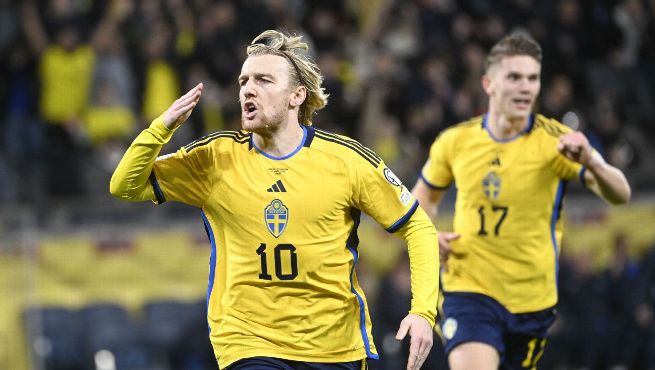
Sweden’s stars like Emil Forsberg (64 national caps, 14 goals), Alexander Isak (29 caps, 11 goals), and Dejan Kulusevski (38 caps, 3 goals) show not just scoring prowess but creative contributions.
Azerbaijan’s key players include Mahir Emreli (47 caps, 6 goals) and Ramil Sheydayev (54 caps, 10 goals). While their goal stats are lower, they often form the heartbeat of Azerbaijan’s counterattacks.
Passing accuracy, possession percentage, and defensive stats also matter. In their latest encounter, Sweden registered a 64 percent possession rate compared to Azerbaijan’s 36 percent. Shots on goal were 15 for Sweden, just 3 for Azerbaijan (Source: Flashscore.com).
# Tactical Analysis: Playing Styles
How do the teams’ tactical approaches shape the statistics?
Sweden typically adopts a 4-4-2 or 4-3-3 formation, favoring possession control and wide play. Their high pressing often leads to early goals and quick midfield transitions. Azerbaijan, on the other hand, relies on compact defending and rapid counter-attacks, seeking to capitalize on rare opportunities.
According to my experience analyzing dozens of European qualifiers, Sweden’s ability to switch play between flanks and utilize overlapping full-backs routinely dismantles the Azerbaijani defensive block. However, Azerbaijan’s goalkeeper, Shahrudin Mahammadaliyev, often impresses with multiple saves per match, sometimes keeping the scoreline closer than expected.
# How to Use Sweden National Football Team vs Azerbaijan National Football Team Stats for Match Prediction
If you want to use these stats to predict outcomes or just impress friends, here’s a step-by-step guide.
1. Gather recent head-to-head results from trusted sites (e.g., UEFA.com, FIFA.com).
2. Analyze squad changes, injuries, and suspensions before each match.
3. Review tactical setups — formation analysis can reveal likely match flow.
4. Compare key stats such as possession, shots on target, and conversion rates.
5. Check recent player form by looking at domestic league performance.
In our team, we always add a “momentum check”: factoring in recent morale, home advantage, and even weather conditions. These can flip a match on its head, especially when the stronger side underestimates the opponent.
# Common Misconceptions and WARNING Section
NOT EVERY BIG WIN TELLS THE FULL STORY. Many believe that a large goal margin means total dominance, but sometimes the score exaggerates the actual balance of play. Skip oversimplifying — look deeper into possession percentages, shot quality, and defensive errors.
Another frequent mistake is assuming historical results will always repeat. Squad evolution, coaching changes, or emerging young stars can reshape dynamics.
BEWARE OF DATA MISINTERPRETATION. Some sites conflate friendlies with official matches, skewing the stats and leading to misleading insights.
# Practical Checklist: Analyzing Sweden vs Azerbaijan Stats
– Confirm match type (friendlies vs qualifiers).
– Always use official sources for statistics (UEFA, FIFA).
– Compare formations used in each match.
– Check player availability for both squads.
– Monitor recent team performance in domestic and international games.
– Review weather and venue conditions on match day.
– Focus on conversion rates and defensive stats, not just final scores.
– Update your analysis before every encounter.
# Conclusion
Digging into sweden national football team vs azerbaijan national football team stats uncovers much more than numbers. It’s about understanding the blend of history, individual stars, tactical evolution, and those invisible influences. Football fans and analysts can gain richer insights—but only if they go beyond the surface. With the data, actionable steps, and expert commentary above, you’re now well equipped for deeper discussions and sharper predictions, every time these teams meet.